Red Flags checks stores: what its result shows
Portal da Queixa has updated Não Sejas Pato Red Flags. In a demonstration, Lyntev observed different figures within one response, without testing scam detection.
By Wellinton OliveiraCEO of Lyntev
Published
3 min read
Key points
- The free service looks for contact details, domain information and other public indicators.
- In one response, the text reported 17 of 19 complaints resolved; a card displayed 94%.
- The observation neither validates nor disproves its ability to detect fraudulent stores.
Portal da Queixa has introduced a new version of its free Não Sejas Pato Red Flags tool to help people check online stores before buying. The service brings together public information about a website and displays a confidence rating. The application itself warns that its analysis uses artificial intelligence and may contain inaccuracies.
In a demonstration conducted by Lyntev on November 27, the response showed how the service works and a discrepancy between figures displayed on the same screen. The query concerned Portal da Queixa’s own domain, which is not a shop. It was not a test of the tool’s ability to detect scams.
What the tool looks for
According to the announcement distributed on November 25 (opens in a new tab), users can enter a website address to consult information about a store, brand or product. The system looks for contact details, social media accounts and other available indicators.
The announced checks include telephone numbers, addresses, domain age, HTTPS connections and tax identification numbers, where these can be found. The existence of information does not, by itself, establish that an order will be delivered. The announcement presents the service as an aid to assessment before a purchase.
The public application (opens in a new tab) distinguishes confidence levels and provides links to sources and Portal da Queixa. In the observed demonstration, it also separated checks on contacts, social media, the domain, the connection and the organisation’s identity. These are features of the interface and the response received, rather than independent validation of every item collected.
The response for the provider’s own domain
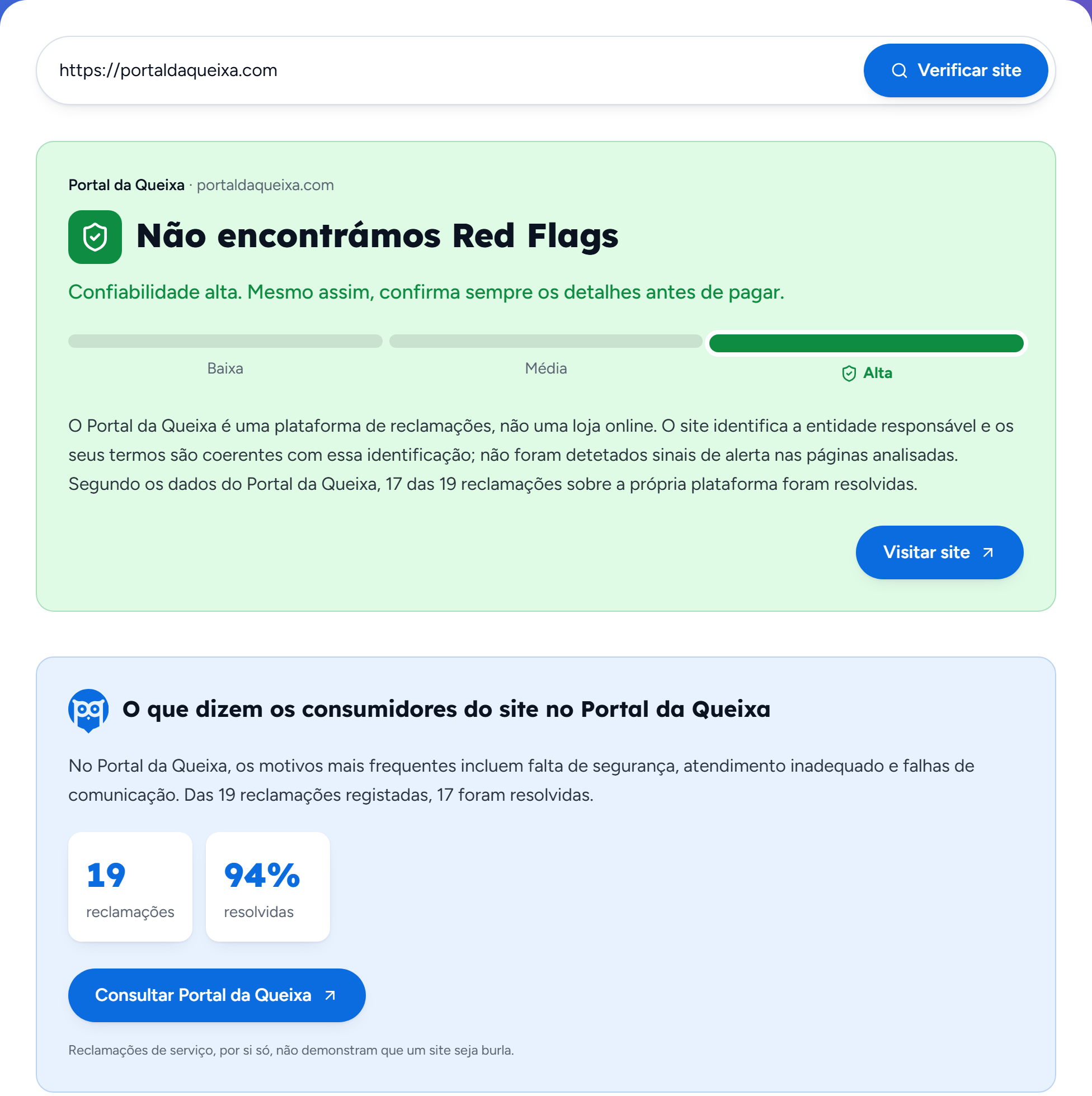
Lyntev entered https://portaldaqueixa.com in the public interface without creating an account, making a purchase or submitting personal information. No documents were uploaded and no customer data was entered; the query used only that public domain. The response was dated November 27, 2026, at 19:02 Lisbon time. The accompanying screenshot reproduces the two panels needed to check the figures discussed here. The figures were not edited for the screenshot.
The system identified the address as a complaints platform rather than a shop and assigned it a high confidence rating. Its text said that 17 of the 19 complaints about the platform itself had been resolved. A card within the same response displayed a resolution rate of 94%.
Dividing 17 by 19 gives approximately 89.5%. Those panels do not explain a different period or denominator that would reconcile 94% with the two figures in the text. This is a discrepancy observed in one specific response; it does not establish the cause or allow conclusions about other results.
The 19 complaints were not checked individually, and the tool was not compared against a set of legitimate and fraudulent stores. The demonstration therefore does not measure accuracy, false alarms or missed detections. It also provides no basis for an allegation of fraud against the provider or the domain analysed.
A confidence rating is not a guarantee
The response itself includes a useful distinction: service complaints do not, on their own, show that a website is a scam. The product’s general notice adds that results are generated by AI using public sources and do not represent Consumers Trust’s official opinion about the organisation being searched.
The service also acknowledges that it does not guarantee the complete accuracy or currency of the information and recommends consulting the sources directly. A rating should therefore be read together with the evidence, links and qualifications accompanying it. An isolated indicator cannot replace that assessment.
In its guidance on safer online shopping (opens in a new tab), Portugal’s National Cybersecurity Centre recommends checking the seller’s credibility, comparing prices and reading the returns conditions, delivery times, costs and contact details. The tool can organise part of that research; the observed response shows why readers also need to check whether the elements it displays agree with one another.
Disclosure: Lyntev, which publishes this site, builds and maintains websites for businesses. About Lyntev.
Sources
Documents, reporting and references gathered for this story. Access limits are stated in the text or the reference itself.
A primary source is the origin of a document or statement; it may be the interested party itself. This label does not mean independent confirmation. The list also includes context and image references where relevant.
- Black Friday: Portal da Queixa lança ferramenta para identificar lojas online suspeitas (opens in a new tab)COMUNICAR-se / Portal da Queixa. Primary source. Accessed 27 November 2026
- Não Sejas Pato: Red Flag (opens in a new tab)Consumers Trust. Primary source. Accessed 27 November 2026
- Resposta pública ao domínio Portal da Queixa,27Nov19h02 (opens in a new tab)Consumers Trust; observação Lyntev. Primary source. Accessed 27 November 2026
- Compras ciberseguras: boas práticas nas compras online (opens in a new tab)Centro Nacional de Cibersegurança. Primary source. Accessed 27 November 2026
Topics

Written by
Wellinton OliveiraCEO of Lyntev
Technology with context, original analysis and sources you can consult.


