SpaceX: observatory calls for international review after licence for up to a million satellites
The European Southern Observatory has called for international review after the US licensed up to a million Starmind satellites. It warns that satellite trails could impair astronomical observations.
By Wellinton OliveiraCEO of Lyntev
Published
Updated
5 min read
Key points
- The FCC authorised SpaceX to deploy and operate up to 1,000,000 Starmind satellites to process data in orbit.
- The European Southern Observatory called for international review on 26 November and warned that satellite trails could impair astronomical observations.
- The first satellite must operate by 25 November 2033. The next milestones are 100,000 by 2035, 500,000 by 2038 and the full constellation by 2040.
- The radio licence covers backup and emergency communications. The FCC deferred a request for an exception to atmospheric re-entry for some satellites.
On 25 November, the US Federal Communications Commission (FCC) authorised SpaceX to deploy up to 1,000,000 satellites for computing in orbit. The project is called Starmind. The 25 November order gives the company until 2033 to put its first satellite into operation. It defers a decision on how some of the satellites could be disposed of at the end of their missions.
What is at stake for astronomy
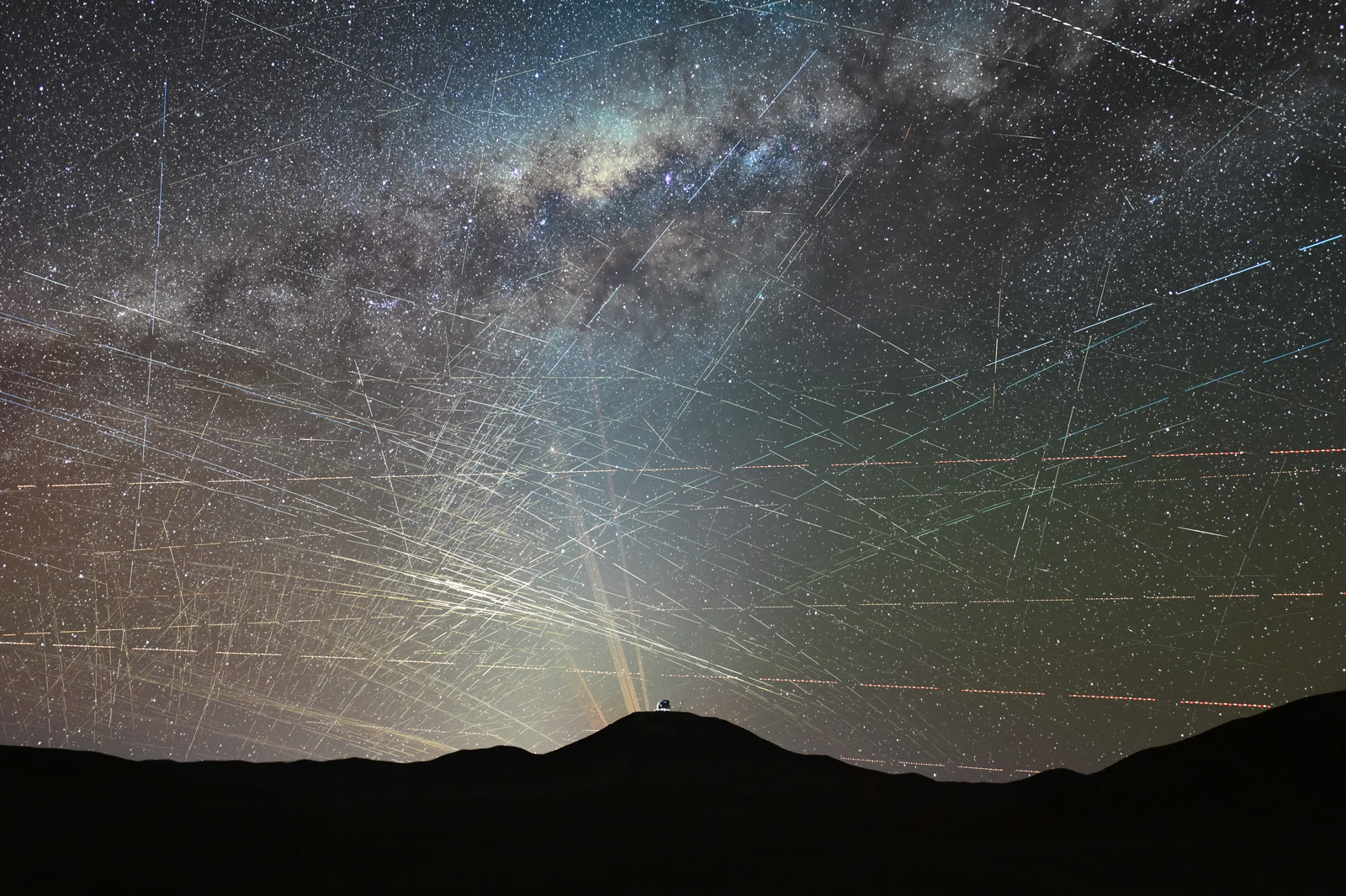
On 26 November the European Southern Observatory (ESO) called for international review of space activities whose effects extend beyond the country authorising them. Director General Andreas Kaufer warned that the scale of the constellation could make faint objects harder to observe, including distant galaxies and some asteroids.
When a sunlit satellite crosses a telescope’s field of view during an exposure, it can leave a trail that spoils part of the image. In a peer-reviewed study in Astronomy & Astrophysics, Olivier Hainaut modelled satellite positions and brightness. In a scenario with a million satellites, field-of-view losses for the FORS2 instrument on the Very Large Telescope reached 28% in some directions.
The figure depends on where the telescope is pointing, the position of the Sun and the satellites’ brightness. It comes from an optical astronomy simulation based on parameters in the proposal. The final licensed configuration may produce different results. In its 25 November response, the American Astronomical Society also warned about the effects that radio emissions and waste heat could have on other observations.
The FCC calls this the first US licence for a constellation of orbital data centres. The modules would process data for use on Earth, including for artificial intelligence, according to the regulator’s announcement. The announcement marks regulatory approval for part of the project. The published documents give no indication that Starmind satellites are already operating.
Four deadlines for keeping the licence
One million is the maximum number of satellites authorised. It is also the final milestone under the schedule attached to the licence. To meet the conditions, SpaceX must get the satellites into their assigned orbits and operate them in accordance with the order as well as launching them.
| Deadline | Licence milestone |
|---|---|
| 25 November 2033 | One satellite in orbit and operating |
| 25 November 2035 | 10% of the maximum, or 100,000 satellites |
| 25 November 2038 | 50% of the maximum, or 500,000 satellites |
| 25 November 2040 | The entire authorised constellation |
The intermediate totals come from applying the percentages in the order to the authorised maximum. These are regulatory milestones. The document sets no date for sales of computing capacity to begin. It specifies a 15-year licence term starting on the date SpaceX certifies to the FCC that the first satellite is in orbit and operating in accordance with the authorisation. The company has five business days to file that certification once the first satellite enters service.
How data would move
The FCC lists authorised altitudes ranging from 500 to 1,002 kilometres. There are six nominal operating bands, with different orbital inclinations. The February notice inviting public comment had described an initial proposal extending to 2,000 kilometres. The November order sets the narrower range in which the system can operate.
The plan described by the FCC relies on optical links between satellites for primary communications, including links to Starlink satellites. The radio licence covers backup and emergency tasks, such as tracking a satellite, receiving data about its condition and sending it commands. If SpaceX receives a documented report of harmful interference, it must stop the operations causing it until the issue is resolved and inform the FCC. Backup links to ground stations also require the relevant ground station authorisations.
Where the satellites go at the end of their missions
Paragraph 11 distinguishes the debris plan for satellites below 600 kilometres, which the FCC found compliant with its rules, from spacecraft above that altitude. Before deploying any Starmind satellite that will operate above 600 kilometres, SpaceX must file a modification application containing its final orbital debris mitigation plan. This condition is separate from the requested waiver of atmospheric re-entry requirements.
The rule cited in the order requires satellites that finish their missions below 2,000 kilometres to be disposed of through atmospheric re-entry. This must be done as soon as practicable, within five years of the end of the mission. SpaceX sought the option of moving some satellites operating above 600 kilometres into designated disposal orbits around the Earth or the Sun. The FCC deferred that part of the application because it had insufficient information to assess the alternatives.
Before deploying and operating satellites that would be disposed of without re-entry, the company must apply to modify the authorisation and justify any requested waiver. The order also calls for reports twice a year on the constellation. They include information about close approaches between objects, re-entries, spacecraft in orbit and use of backup communications.
What the FCC assessed and what it left outside the decision
The FCC denied petitions from Kuiper Systems, Viasat and the American Astronomical Society seeking to block the licence. The society argued that waste heat from so many spacecraft could affect infrared astronomy. The FCC considered the effect outside the scope of the radio operations under review. Its order also placed questions about the economics of orbital data centres and the challenges of managing their heat outside that scope.
On environmental matters, the FCC decided not to require further review of the system under the US National Environmental Policy Act, or NEPA. It invoked its October decision on the law’s scope and stated that it would not require that review under its earlier rules either. The order points to the aviation authority, the FAA, for environmental review of launches. This is the FCC’s position in this proceeding, not a finding of zero environmental impact or blanket permission for every project activity.
Starmind has cleared a regulatory step with conditions attached. The first evidence of operation identified by the order would be certification of a single satellite. The price of computing, the capacity available and when a commercial service could begin remain open questions.
Corrections
. Clarified the modification application and final debris-plan requirement for any Starmind above 600 kilometres, separate from the re-entry waiver request, which remains deferred; added the scope of the FCC’s environmental decision.
. Added the European Southern Observatory’s position, the scope of the satellite-trail study and the American Astronomical Society’s response. The ESO archive image shows actual trails over the Atacama Desert.
Sources
Documents and reporting consulted for this story.
- DA 26-1273 – Memorandum Opinion and Order and AuthorizationFederal Communications Commission, . Primary source. accessed 25 November 2026
- FCC Authorizes 1 Million Satellites for Data Centers in SpaceFederal Communications Commission, . Primary source. accessed 25 November 2026
- DA 26-113 – Space Bureau Accepts for Filing SpaceX’s Application for Orbital Data CentersFederal Communications Commission, . Primary source. accessed 25 November 2026
- ESO statement on approval of launch of one million space data centresEuropean Southern Observatory, . Primary source. accessed 26 November 2026
- Large or bright satellite constellations: Effects on observations, including background sky brightnessAstronomy & Astrophysics. Primary source. accessed 26 November 2026
- AAS Leadership Available to Comment on FCC Approval of SpaceX’s Orbital Data Center SystemAmerican Astronomical Society, . Primary source. accessed 26 November 2026
Topics

Written by
Wellinton OliveiraCEO of Lyntev
Technology with context, original analysis and sources you can consult.


