Memristors tune time in a prototype that recognises digits
The duration of an electrical response helps represent recent events. The experimental system uses reduced inputs and is not a general-purpose AI processor.
By Wellinton OliveiraCEO of Lyntev
Published
3 min read
Key points
- The peer-reviewed study was published on 26 November.
- The experimental array contains 392 devices in 28 by 14 positions.
- The 91.14% refers to classification of reduced N-MNIST digits, not general artificial intelligence.
- Energy of 4.040 microjoules per pattern is estimated, rather than a physical side-by-side test.
A prototype containing 392 diffusive memristors recognised digits in a neuromorphic dataset with 91.14% accuracy. The result, published on 26 November in Nature Materials, demonstrates control over how long these components retain an electrical response. It used reduced inputs and an experimental system containing another computing circuit, rather than a general-purpose artificial intelligence processor.
Yunzhi Ling and Qiangfei Xia’s team at the University of Massachusetts Amherst and collaborators addressed a uniformity problem. The devices can conduct temporarily and return to their initial state after stimulation. This short memory can represent elapsed time, but a reliable system is difficult to build if components recover unpredictably.
The peer-reviewed study was accepted on 26 October. Its contribution is the combination of material engineering, electrical control and an array-level demonstration in the reviewed publication. It does not introduce the first use of memristors to emulate neuronal functions.
A fading memory can represent time
A memristor changes electrical resistance in response to previous stimulation. In the diffusive type studied here, silver ions form a conducting path that subsequently dissolves. Instead of permanently retaining a number, the decline in conductance can record how recently an event occurred.
In a “time surface” algorithm, recent events leave a stronger response than older ones. This helps identify patterns in a sequence of signals rather than processing only a static photograph. The prototype implements two layers of HOTS, short for hierarchy of time surfaces.
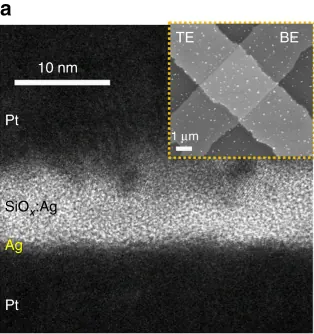
The accompanying image documents a different diffusive device investigated by Jung Ho Yoon and colleagues in 2018. Microscopy reveals its physical layers and structure. That work used silicon oxide and explored responses resembling a receptor for harmful stimuli; it is not the 2026 array. It provides context for the technology’s transient mechanism, which predates the new uniformity controls.
Materials and current tune the response
The new device introduces a thin platinum network at an interface and uses polycrystalline hafnium oxide. According to the researchers, openings in the network and boundaries between oxide grains confine ion migration, reducing variation in the response.
The current limit during programming provides a further adjustment. The supplement reports device relaxation times from 0.47 to 118 milliseconds; the processing demonstration uses a narrower window. In the 28-by-14 array, 336 components were programmed for a shorter response and 56 for a longer one. The maps show bands of approximately 3–6 and 35–50 milliseconds.
This is laboratory control, with supplementary tests covering switching cycles and retained relaxation after one million pulses. Those tests do not establish a product’s service life, manufacturing yields for large arrays or reliable operation in every environment.
What 91.14% accuracy measures
The test uses N-MNIST, which represents digits through neuromorphic events. Inputs were reduced from 28 by 28 to 14 by 14 positions to fit the available hardware. The 91.14% result applies to that two-layer configuration with a simple final classifier.
In the supplementary control, the same processing pipeline using an unoptimised device achieved 37.52%. That comparison supports the importance of a more uniform physical response within this experiment. It does not establish superiority over every image-recognition system or transfer the percentage to video, language or real-world deployment.
The diffusive array also does not perform the entire task alone. The system includes an integrated circuit with non-volatile memristor crossbars for computation, a processor and readout electronics. The authors provide code and instructions on GitHub. Lyntev consulted the documentation without carrying out an experimental reproduction.
Energy savings remain an estimate
The supplement estimates approximately 4.040 microjoules per pattern for its chosen analogue configuration, including signal generation, computation and peripheral circuitry. Among other assumptions, this uses 100 time surfaces in each layer and estimated transfer times.
The comparison with Intel’s Hala Point system uses an operations model and published platform values, rather than a side-by-side measurement of the same task on both machines. The approximately 3.62-fold difference reported by the authors applies to that calculation. The scientific contribution is showing that a material’s dynamics can participate in temporal processing; the energy advantage and industrial scaling require further validation.
The paper discloses a pending provisional patent involving Qiangfei Xia and Yunzhi Ling for the devices and methods. TetraMem partly funded the research and loaned the evaluation kit used. These relationships are part of the study’s disclosed context when assessing its proposed applications.
Sources
Documents and reporting consulted for this story.
- Tunable diffusive memristor arrays for neuromorphic temporal computingNature Materials — Yunzhi Ling e colaboradores, . Primary source. accessed 27 November 2026
- Supplementary Information: figuras1–22, notas1–3 e tabelas1–2Autores / Nature Materials, . Primary source. accessed 27 November 2026
- HOTS using diffusive memristor — documentação e códigoYunzhi Ling / GitHub. Primary source. accessed 27 November 2026
- An artificial nociceptor based on a diffusive memristorJung Ho Yoon e colaboradores / Nature Communications, . Primary source. accessed 27 November 2026
Topics

Written by
Wellinton OliveiraCEO of Lyntev
Technology with context, original analysis and sources you can consult.


