AhnLab finds remote access trojan in official Q-Dir and DesktopOK installers
Anyone who installed or updated these two free Windows utilities in recent weeks should check their files. Reinstalling alone will not clean the machine, researchers warn.
By Wellinton OliveiraCEO of Lyntev
Published
5 min read
Key points
- AhnLab confirmed that Q-Dir and DesktopOK installers on the official SoftwareOK site installed a remote control program written in Python.
- Q-Dir 12.83, 12.84 and 12.85 and DesktopOK 12.82 and 12.85 are affected, including copies delivered by the automatic update.
- The malware runs commands, transfers files, takes screenshots and looks for 1,206 security product processes.
- Uninstalling does not remove it: AhnLab says to look for a scheduled task and a folder under ProgramData, check the SHA-256 and scan the PC.
- How the files were swapped, and for how long, is unknown; the developer has not responded.
Some installers for two free Windows utilities, Q-Dir and DesktopOK, were tampered with on the developer's own website to install a remote control program. That is the finding of the research centre of South Korean security firm AhnLab, which describes the case as a software supply chain attack. Anyone who installed or updated these tools in recent weeks should check their files, and reinstalling is not enough to clean the computer.
The AhnLab Security Intelligence Center (ASEC) report, whose Korean edition is dated 27 November, says the malicious files arrived by two routes: direct download from the official page and the update of legitimate copies already installed. What caused the swap is still unknown.
What Q-Dir and DesktopOK are
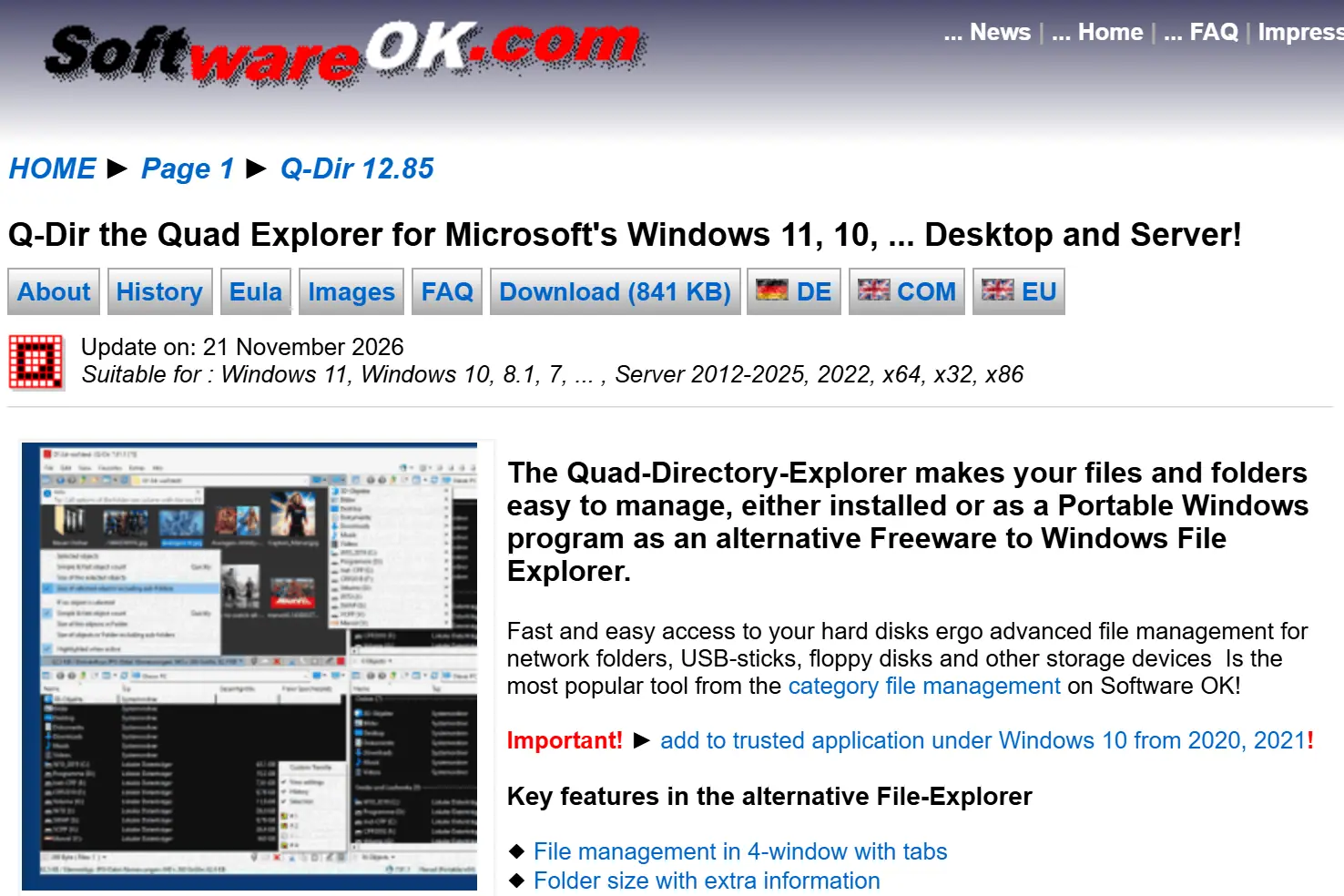
Both programs are written by Nenad Hrg, who distributes them free of charge on his SoftwareOK website. Q-Dir is a file manager that shows up to four explorer panes on one screen. DesktopOK saves and restores the position of desktop icons, which helps when switching monitors or screen resolution.
They are not mass-market applications, but BleepingComputer notes that IT professionals, system administrators and power users rely on them. That audience often holds privileged access to company networks.
An attack through the channel users trust
A supply chain attack does not try to lure the user to a fake site or an advert. It replaces the genuine file at the place it is downloaded from. ASEC stresses that the malicious code did not come from unofficial mirrors but from SoftwareOK's official distribution path.
The tampered installer carries the legitimate executable inside it. According to ASEC, that executable has the same SHA-256 value published on the download page and a valid digital signature from Nenad Hrg. A SHA-256 hash works like a fingerprint for a file: it changes completely if a single character is altered, as Microsoft's documentation explains.
When run, the installer launches Q-Dir or DesktopOK from the C:\Users\Public folder. To the person at the keyboard, everything looks normal. In the background, it downloads from an external server 7zr.exe, a legitimate 7-Zip decompression tool, and a package containing the malware and Python itself.
That program is a RAT, or remote access trojan: hidden software that lets a third party control the computer from afar. Because it brings its own Python runtime, it works even on machines that never had Python installed.
Which versions are affected
ASEC confirmed that files were replaced in the versions below. BleepingComputer adds that not every copy of each version was infected.
| Program | Versions with replaced files | Version on the official page on 28 November |
|---|---|---|
| Q-Dir | 12.83.0.0, 12.84.0.0, 12.85.0.0 | 12.85 |
| DesktopOK | 12.82.0.0, 12.85.0.0 | 12.88 |
ASEC warns that the version number settles nothing on its own. Anyone who installed or updated during the distribution period should assume they are at risk, even with a different version. Q-Dir 12.85 is on the list and was also the version offered on the official page on 28 November. ASEC says to reinstall the latest version, but only after checking that the downloaded file's SHA-256 matches the published one: that value, not the version number, separates a clean copy from a tampered one.
What the malware does
The RAT connects to a command-and-control server, the machine that issues orders, at 8.210.69[.]51 on port 9876. From there, according to ASEC, its operator can run commands and Python code, send and receive files, take screenshots and collect system information.
The program also compares running processes against a list of 1,206 names linked to antivirus and corporate detection tools. The list covers Korean brands, AhnLab included, and international ones such as CrowdStrike, ESET, Kaspersky, Bitdefender and Sophos. The result goes to the server, which helps the attacker plan the next step without being detected.
ASEC found comments in Chinese in the code. It says this suggests a link to a Chinese-speaking environment, without attributing the attack to a specific group.
How to tell whether a computer was affected
The ASEC report points to three concrete signs. The first is the folder C:\ProgramData\Microsoft\DeviceSync\b2, or alternatively C:\ProgramData\DeviceSync\b2, where the package is installed. The second is a scheduled task named MicrosoftEdge_dcntel, inside a UPnp folder of Task Scheduler, which makes the RAT start automatically.
The third is the process itself: the task runs pythonw.exe from a py39 subfolder to execute a file called py_client_dsv2.py. Ongoing connections to the address above are another warning sign.
To check a saved installer, the Q-Dir and DesktopOK download pages publish the SHA-256 value of each file. On Windows, PowerShell's Get-FileHash command calculates it, using SHA-256 by default. If the result does not match the page, the file is not the original.
What to do, according to AhnLab
ASEC recommends uninstalling the program and reinstalling the latest version, after confirming that the SHA-256 of the downloaded file matches the published value. It warns, however, that uninstalling does not remove a RAT that is already installed.
That means looking for the traces described above: unexpected Python environments, scheduled tasks, related files and external network traffic. Then update the antivirus and run a full system scan.
If there are signs of infection, ASEC says the computer should be cut off from the network and the extent of the damage assessed, including any further malware run and possible data leaks. Because the RAT can see the screen and files, the firm warns that work data and account details may be exposed. It asks developers to apply code signing and hash checks along the whole path, from build to distribution.
Two accounts of the signature
The sources differ on one point. BleepingComputer writes that the tampered versions are signed with a certificate issued to the developer. ASEC's public text confirms the valid signature of the embedded legitimate executable, but does not explicitly say the same about the malicious installer.
SoftwareOK's version histories, read on 28 November, do not mention the attack. The notes for Q-Dir 12.84, dated 13 November, and 12.85, dated 21 November, describe updates prompted by virus alerts the author calls false positives. The note for DesktopOK 12.85, dated 19 November, mentions an auto-update issue. Nothing in the sources links these notes to the incident.
How the files were swapped, and since when
ASEC has not identified how the legitimate installers were replaced or how long the malicious ones were available. BleepingComputer mentions user complaints going back about two weeks, but there is still no start date and no count of victims.
BleepingComputer contacted Nenad Hrg and had no reply by publication. Günter Born's German blog and the Seoul Economic Daily also reported the case based on AhnLab's findings. Without the developer's account, the attackers' point of entry and any assurance that the site is now clean remain open questions.
Sources
Documents, reporting and references gathered for this story. Access limits are stated in the text or the reference itself.
A primary source is the origin of a document or statement; it may be the interested party itself. This label does not mean independent confirmation. The list also includes context and image references where relevant.
- Software Supply Chain Attack via the Official SoftwareOK Website: Tampering with Q-Dir and DesktopOK Installation FilesAhnLab Security Intelligence Center (ASEC), . Primary source. accessed 28 November 2026
- Q-Dir and DesktopOK Windows utilities compromised to push Python RATBleepingComputer — Bill Toulas, . accessed 28 November 2026
- Malware Found in Downloads From Official Q-Dir, DesktopOK SiteSeoul Economic Daily — Kim Ji-won, . accessed 28 November 2026
- Sammelbeitrag: Sicherheits-News zum 27.11.2026Borns IT- und Windows-Blog — Günter Born, . accessed 28 November 2026
- Q-Dir — Program HistorySoftwareOK — Nenad Hrg. Primary source. accessed 28 November 2026
- DesktopOK — Version HistorySoftwareOK — Nenad Hrg. Primary source. accessed 28 November 2026
- Q-Dir 12.85 DownloadSoftwareOK — Nenad Hrg. Primary source. accessed 28 November 2026
- DesktopOK DownloadSoftwareOK — Nenad Hrg. Primary source. accessed 28 November 2026
- Get-FileHash (Microsoft.PowerShell.Utility)Microsoft Learn. Primary source. accessed 28 November 2026
Topics

Written by
Wellinton OliveiraCEO of Lyntev
Technology with context, original analysis and sources you can consult.