Model links diet and thaw to mercury exposure in the Yukon
Research combines food resources and frozen ground in the Yukon River Basin. Estimated effects vary with food substitutions and environmental assumptions.
By Wellinton OliveiraCEO of Lyntev
Published
4 min read
Key points
- The study published on 27 November combines simulated diets with thaw-related mercury scenarios.
- Replacing salmon with other fish or terrestrial mammals produces different outcomes in the model.
- Food data predate the recent fisheries collapse; current local measurements are still needed.
A study published on Friday, 27 November, links two pressures on Indigenous communities relying on subsistence foods in Alaska's Yukon River Basin: declining access to salmon and thawing ground that stores mercury. Its simulations show that replacing foods can amplify or reduce estimated exposure to the metal. They do not measure a current increase in contamination in people.
The research by M. Isabel Smith and colleagues appears in Nature Communications, following peer review and with open access. Its contribution is to combine dietary and environmental scenarios that each leave out part of the problem when examined alone. The findings depend on which foods replace salmon and where additional mercury enters the food web.
How the Yukon diets were constructed
The team assembled records of foods harvested by Alaskan communities between 2010 and 2018, before the recent collapse of salmon fisheries. It combined them with dietary surveys, including a 2004 survey, and published mercury concentrations. Inland and coastal communities were considered separately because they rely on different resources.
The model generated 10,000 daily diets for a reference person weighing 77 kilograms and consuming 2,020 calories per day. It then selected days to construct annual estimates. These are calculated combinations, rather than meals observed in participants followed for a year.
In the substitution scenarios, salmon was removed and replaced with other fish or moose and caribou meat. Environmental scenarios increased mercury in fish using earlier projections associated with permafrost thaw. The team tested both changes confined to resident freshwater fish and changes affecting all fish and marine mammals.
Changing protein changes the outcome
Salmon is not interchangeable with every food that might replace it. In the model, fish such as northern pike can carry more mercury, while terrestrial mammal meat has a different profile. Losing access to a species can therefore change exposure even without adding mercury to the environment.
| Simulated replacement for salmon | Inland | Coastal |
|---|---|---|
| Other fish | +116% | +48% |
| Moose or caribou | −48% | −21% |
Source: Smith and colleagues, compared with the reference diet, without the environmental increase associated with thaw.
Combining other fish with the most severe thaw scenario produced an estimated increase of up to 486% inland. That maximum assumes mercury increases in all fish and marine mammals. It does not mean that every resident will experience that exposure, or that blood concentrations will rise by the same proportion.
Almost complete food substitution also simplifies real decisions. Seasonal availability, harvesting effort, food sharing and traditions can restrict access to alternatives. The authors themselves acknowledge that greater reliance on shop-bought foods could change their estimates.
The salmon agreement has specific exceptions
The research takes place against an existing restriction, rather than a ban introduced by the new study. The agreement between Canada and Alaska, signed in April 2024, covers Canadian-origin Chinook salmon through 2030. It suspends directed fisheries in the mainstem Yukon and Canadian tributaries.
For subsistence fishing, a limited opening may be considered if forecast border passage exceeds 71,000 fish, after accounting for losses along the route. The agreement also permits limited harvests for ceremonies and the transmission of cultural knowledge. Describing it as an absolute ban on all salmon would therefore erase important distinctions.
The document prioritises rebuilding stocks, research and traditional ecological knowledge. Reading it alongside the study reveals a connection between conservation and food: protecting salmon can also preserve dietary options. The simulation does not decide which choices communities should make.
Frozen ground is part of the pathway
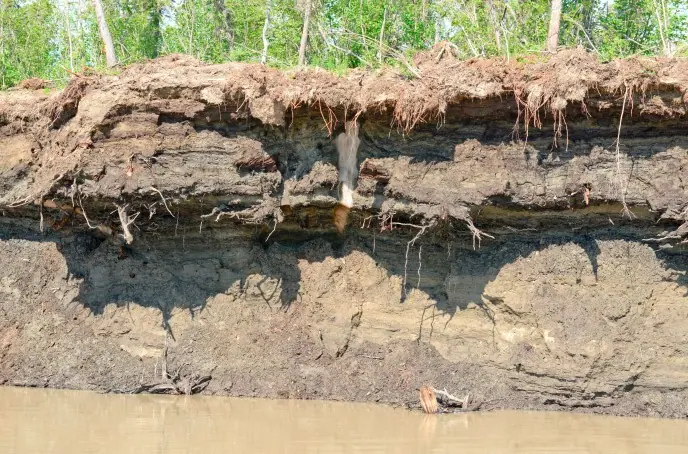
Permafrost is ground that remains frozen for years. The National Park Service documents ice wedges in sediments along the Yukon itself. The photograph accompanying this article shows that exposed structure in an archive image, rather than a sampling visit for the new study.
The USGS mercury laboratory describes monitoring total mercury and methylmercury, a form of the metal that accumulates in food webs, at Pilot Station. Sampling takes place monthly during the ice-free season and also under ice. The agency highlights uncertainty about how mercury cycling will respond to warming.
Current food and exposure measurements are still needed
The new research calculates total mercury without separately estimating methylmercury and inorganic mercury, which differ in how the body absorbs them. Its comparison with health thresholds combines reference values for those forms. That approximation calls for care: estimated intake is neither an absorbed dose nor a diagnosis.
The authors call for updated measurements in foods, ecosystems and diets, linked to information about species availability. Such data would help test the scenarios and their local variation. For now, the finding is a quantitative hypothesis about interacting pressures, rather than individual dietary advice.
Sources
Documents, reporting and references gathered for this story. Access limits are stated in the text or the reference itself.
A primary source is the origin of a document or statement; it may be the interested party itself. This label does not mean independent confirmation. The list also includes context and image references where relevant.
- Changing mercury exposure in the Yukon Watershed linked to traditional diet shifts and permafrost thawNature Communications — Smith e colegas, . Primary source. accessed 27 November 2026
- Agreement of April 1, 2024 regarding Canadian-origin Yukon River Chinook Salmon for 2024 through 2030Fisheries and Oceans Canada e Alaska Department of Fish and Game, . Primary source. accessed 27 November 2026
- Mercury Assessments — Mercury Cycling in AlaskaU.S. Geological Survey — M3 Research Laboratory. Primary source. accessed 27 November 2026
- Permafrost — Yukon-Charley Rivers National PreserveNational Park Service. Primary source. accessed 27 November 2026
- Disclaimer — OwnershipNational Park Service. Primary source. accessed 27 November 2026
Topics

Written by
Wellinton OliveiraCEO of Lyntev
Technology with context, original analysis and sources you can consult.