Measles deaths fall to record low as US, Mexico and Bolivia lose elimination status
Vaccination has saved more than 60 million lives since 2000, the WHO calculates. But coverage has stalled and the virus is circulating unchecked again in countries that had eliminated it.
By Wellinton OliveiraCEO of Lyntev
Published
5 min read
Key points
- The WHO estimates 72,000 measles deaths in 2025, the lowest on record and 91% fewer than in 2000.
- PAHO announced on 17 November that Bolivia, Mexico and the United States had lost their elimination status after at least 12 months of continuous transmission.
- Only 77% of children worldwide received a second dose in 2025; stopping outbreaks requires 95% coverage with two doses.
- Portugal has confirmed 24 cases this year, 14 of them in the Lisbon and Tagus Valley region since 6 October, according to its health authority.
Measles killed an estimated 72,000 people in 2025, the lowest figure on record, according to estimates released on 27 November by the World Health Organization (WHO). That is a 91% fall since 2000. In the same report, the agency warns that the virus is regaining ground in countries that had eliminated it, starting with the United States, Mexico and Bolivia.
The WHO calculates that measles vaccination has prevented more than 60 million deaths since 2000. Even so, nearly 10 million people were infected in 2025 and 59 countries had large or disruptive outbreaks. Eleven of those outbreaks hit countries that had previously been declared measles-free.
The figures come from “Progress towards measles elimination – worldwide, 2000–2025”, published in the WHO's Weekly Epidemiological Record.
Deaths and infections are estimates, not counts of notified cases. The WHO uses them to compare trends over 25 years.
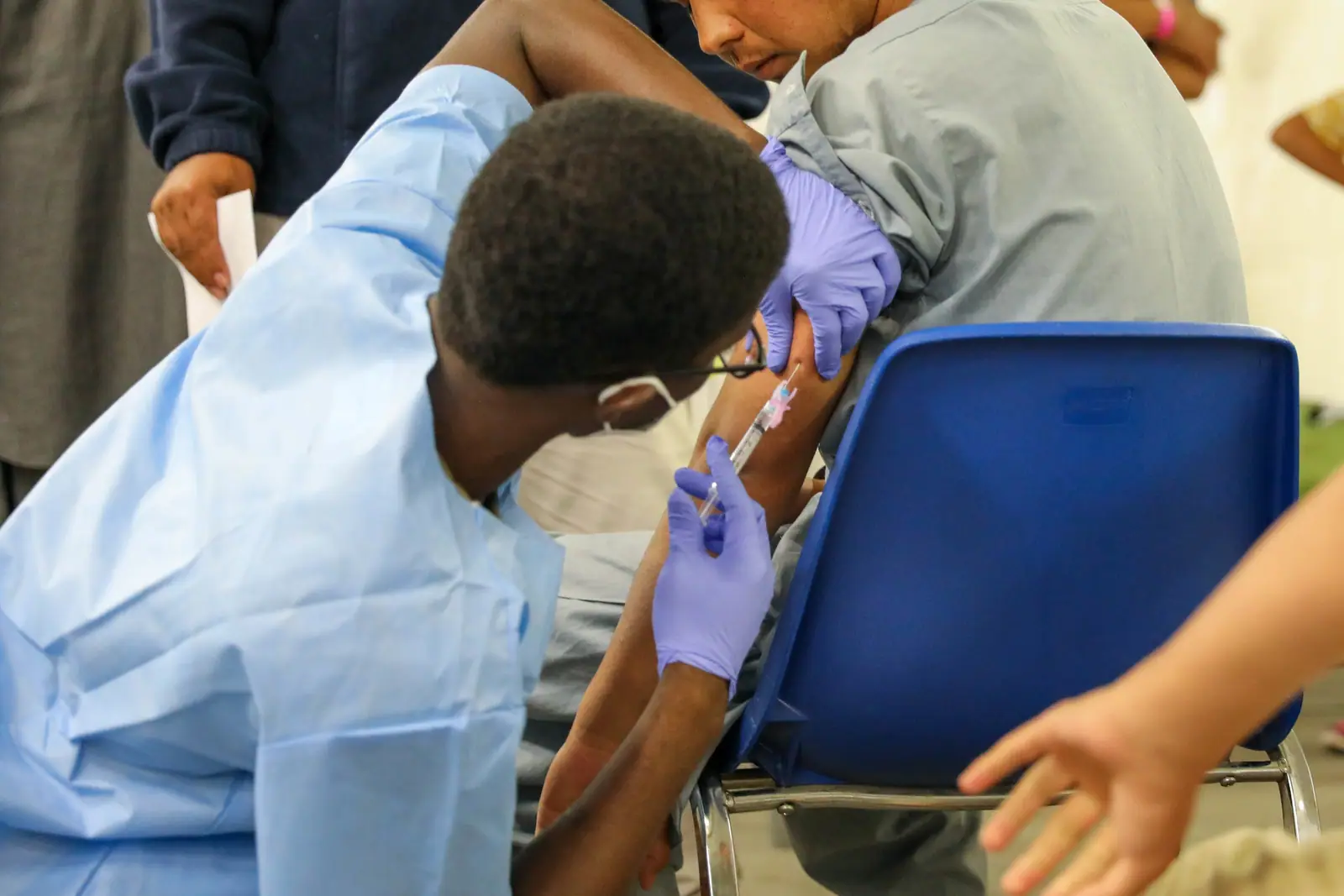
Global vaccination coverage was largely unchanged from the previous year. In 2025, 84% of children received a first dose and 77% a second. More than 29 million children were unvaccinated or under-immunised.
“Measles does not forgive complacency,” said WHO Director-General Tedros Adhanom Ghebreyesus, stressing that elimination “is not a finish line”.
The gap between rich and poor countries
The global average hides wide differences. Low-income countries gave the first dose to 69% of children and the second to 57%. In high-income countries the figures were 93% and 91%.
| Country group (2025) | 1st dose | 2nd dose |
|---|---|---|
| World | 84% | 77% |
| Low income | 69% | 57% |
| High income | 93% | 91% |
| Level needed to stop outbreaks | 95% | 95% |
Source: WHO report of 27 November 2026; level needed to stop outbreaks according to PAHO and WHO Europe.
Nearly half of all cases worldwide were in South-East Asia. According to UN News, that region has the highest first-dose coverage of any, at 96%. The report uses the example to show that a strong regional average can conceal pockets of unvaccinated people.
What losing measles elimination status means
A country has “eliminated” measles when there is no endemic transmission, meaning the virus no longer circulates continuously inside its borders. Imported cases still occur. What matters is whether the same chain of infection stays alive.
In the Americas the rule is precise: status is lost when the same genotype and lineage of the virus circulate uninterrupted for 12 months or more. That is what the Pan American Health Organization (PAHO) concluded on 17 November about Bolivia, Mexico and the United States, after an expert commission met from 10 to 13 November.
The Americas were the first region in the world to eliminate measles. They regained the status in 2024 but lost it again in November 2025 because of sustained transmission in Canada. By 13 November this year, the region had recorded 58,213 confirmed cases and 82 deaths, against 12,806 cases in the same period of 2025.
The WHO had 95 countries verified as measles-free at the end of 2025; according to WHO data cited by UN News, there are now 92.
Measles in the United States: 6,039 cases in a year
The CDC counted 6,039 confirmed cases in the United States in 2026 up to 24 November, across 47 jurisdictions. There were 2,289 in 2025 and 285 in 2024. The agency records nine deaths this year, a figure it describes as provisional.
Measles had been declared eliminated in the country in 2000. Meanwhile, according to the CDC, coverage of the MMR vaccine (measles, mumps and rubella) among kindergarten children dropped from 95.2% in the 2019–2020 school year to 92.4% in 2025–2026. That leaves about 280,000 children unprotected.
In Mexico, the European Centre for Disease Prevention and Control (ECDC) counts 20,386 cases and 50 deaths since the outbreak began in 2025.
Measles in Portugal and Europe: 24 cases this year
In Europe, the problem appeared earlier. In September 2025, the WHO's European verification commission found that 19 countries had continuing or re-established endemic transmission, up from 12 a year earlier, according to WHO Europe. In January, the WHO announced that the United Kingdom and several other European countries had lost their status, Reuters reported.
In the European Union and European Economic Area, outbreaks are smaller than in the Americas. The ECDC counted 2,325 cases between October 2025 and September 2026, with no deaths attributed to measles. Among cases with known vaccination status, 71.8% were unvaccinated. Among the countries with updated figures from the ECDC, Bulgaria has 592 cases this year and Spain 163.
In Portugal, the Directorate-General of Health (DGS) confirmed 24 cases between 1 January and 22 November, according to its statement as reported by Observador. Fourteen were detected in the Lisbon and Tagus Valley region since 6 October: 12 adults, one child and one baby under a year old.
Three of those cases were imported by people who had travelled to a country with high virus circulation. One of them led to a chain of seven secondary cases; two of those secondary cases had no record of vaccination. No patient was in hospital at the time of the statement.
Measles vaccine: why the target is 95% with two doses
Measles is one of the most contagious diseases known. One infected person can pass it to as many as 18 people without immunity, according to PAHO. It can cause pneumonia, encephalitis (inflammation of the brain), blindness and death, and it weakens the body's defences for months.
With 95% of the population vaccinated with two doses, the virus can no longer find enough people to spread. That protects those who cannot be vaccinated: babies under 12 months and people with weakened immune systems. According to WHO Europe, two doses give up to 97% lifelong protection.
Portugal is above the target among children. The 2024 report of the National Vaccination Programme, cited by the magazine Sábado, put first-dose coverage at 99% by age two and second-dose coverage at 96% by age six. Most of this autumn's cases, however, are in adults.
When the US, Mexico and Bolivia can return
None of the organisations says how long it will take the United States, Mexico and Bolivia to regain their status. According to PAHO, all three are strengthening vaccination, surveillance and outbreak response. Canada has already interrupted the chain of transmission that cost it its status and is working to regain it.
The WHO calls for political commitment, stronger surveillance, routine immunisation and rapid outbreak response, including through a partnership fund. Children in conflict and crisis settings are the least likely to be vaccinated. Without high coverage in every community, the agency warns, the virus can quickly regain a foothold.
Sources
Documents, reporting and references gathered for this story. Access limits are stated in the text or the reference itself.
A primary source is the origin of a document or statement; it may be the interested party itself. This label does not mean independent confirmation. The list also includes context and image references where relevant.
- Historic low in measles deaths, but immunization gaps threaten progressOrganização Mundial da Saúde, . Primary source. accessed 29 November 2026
- Measles deaths hit historic low, but US, Mexico and Bolivia lose elimination statusUN News, . accessed 29 November 2026
- PAHO urges countries to step up efforts to stop measles outbreaks and move towards elimination in the AmericasOrganização Pan-Americana da Saúde, . Primary source. accessed 29 November 2026
- Measles Cases and OutbreaksCenters for Disease Control and Prevention, . Primary source. accessed 29 November 2026
- Measles – Multi-country (World) – Monitoring European outbreaks – Monthly monitoring, 6 November 2026European Centre for Disease Prevention and Control, . Primary source. accessed 29 November 2026
- Measles cases dropped in Europe and Central Asia in 2025 compared to the previous year, but the risk of outbreaks remains – UNICEF and WHOOMS Europa e UNICEF, . Primary source. accessed 29 November 2026
- European countries including U.K. lose measles elimination statusReuters (via CTV News), . accessed 29 November 2026
- DGS confirma 14 novos casos de sarampo em Lisboa e Vale do Tejo desde outubro, elevando para 24 o total de 2026Observador (Lusa), . accessed 29 November 2026
- Portugal com mais de 98% das crianças vacinadas no 1.º anoSábado (Lusa), . accessed 29 November 2026
Topics

Written by
Wellinton OliveiraCEO of Lyntev
Technology with context, original analysis and sources you can consult.