Study shows how reference choices change genomic tool rankings
Researchers compared long reads from two samples against three human reference genomes. Higher scores may reflect easier regions being evaluated.
By Wellinton OliveiraCEO of Lyntev
Published
3 min read
Key points
- The peer-reviewed study was released early on 27 November.
- Seven programs were assessed using different variant sets, references and regions.
- No tool performed best in every scenario; a more complete reference includes difficult regions.
- The work provides code and data without validating a clinical use or all human diversity.
A study published in Nature Communications on 27 November shows that rankings of programs detecting structural changes in genomes can shift with the reference used to assess them. The team compared seven tools analysing long sequencing reads. Results varied substantially with the variant set treated as correct, the reference genome and the regions included.
The findings do not identify a universal winner or demonstrate an error in a particular diagnosis. They question comparisons between evaluations that appear to measure the same task but use different standards. The peer-reviewed article was released early after acceptance; the publisher says further edits will precede the final version.
The comparison standard is also a choice
Structural variants are relatively large changes in DNA. This study restricted its analysis to unbalanced changes longer than 50 base pairs, including insertions, duplications and deletions. It does not evaluate every form of genetic variation.
Researchers measure a program’s performance by comparing its predictions with a reference set of variants, often called a “ground truth”. The name does not make that set infallible. It may come from consortium curation or from programs comparing an assembled individual genome with a reference sequence.
In the original paper, Luca Denti and colleagues examine precisely these choices. The research involves institutions in Slovakia, Germany, France, Italy and the United States.
Two samples and three human reference genomes
The main analysis uses HG002, an extensively studied sample with PacBio HiFi reads, high-quality assemblies and Genome in a Bottle consortium variant sets. The team also examined NA12878 from the Platinum Pedigree Consortium to check whether the conclusions depended on a single sample.
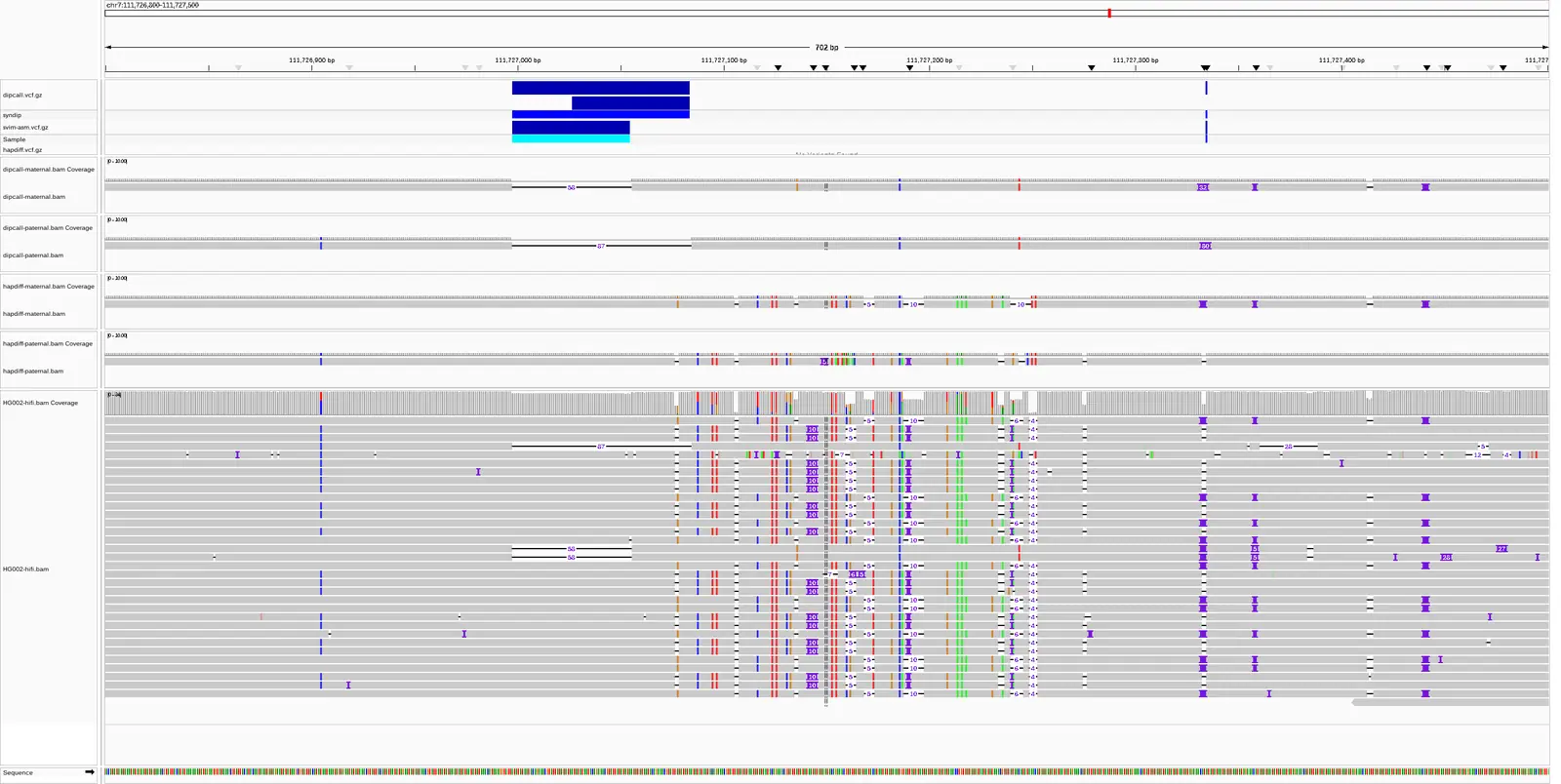
Three programs, dipcall, SVIM-asm and hapdiff, generated comparison sets from the same assemblies. The authors then evaluated seven tools working directly from long reads. They repeated comparisons with GRCh37, GRCh38 and T2T-CHM13, three human reference genomes with different degrees of completeness.
This design shows how scores change when the evaluation changes. It does not make two reference samples representative of all human diversity, or turn the work into a clinical trial involving patients.
A more complete reference can lower the score
The F1 measure combines precision with the ability to recover variants present in the set used as the standard. Here, a lower score may reflect a harder task, rather than a program that has deteriorated.
In whole-genome comparisons that harmonised differing representations of variants, the tools’ average F1 changed with the reference:
| Reference | Mean whole-genome F1 | Mean F1 in regions considered confident |
|---|---|---|
| GRCh37 | 80.5% | 84.2% |
| GRCh38 | 74.8% | 80.6% |
| T2T-CHM13 | 59.5% | 70.0% |
Source: study results for HG002 and assembly-derived comparison sets. These figures are not diagnostic accuracy rates.
T2T-CHM13 includes difficult regions absent or less resolved in earlier references. When the authors restrict comparisons to regions corresponding to GRCh38, performance improves. The study therefore does not support the claim that an older reference is biologically better because it produces higher scores.
Variant representation can change the ranking
Programs may describe a change as a single event or split it into several nearby events. They also use different strategies to align sequences and merge predictions. These differences influence comparisons even when the initial data are identical.
The team used Truvari to compare variant sets and tested a harmonisation step intended to reconcile different representations of the same variation. Tool rankings shifted with this option and the set treated as correct. No tool performed best in every tested condition.
The authors provide SVBench-FW, an analysis workflow bringing together the tools and scripts used in the study. Public code and data allow scrutiny; their availability does not mean Lyntev repeated the analysis or independently validated every prediction.
Broader parameter and population comparisons remain necessary
The paper identifies its own limitations. Comparisons depend on Truvari and how it matches variants; methods comparing the underlying sequences directly could resolve some ambiguities. The assessment of different program parameters was also limited.
For readers interpreting genomic research, the implication is to check the standard, reference and evaluated region before comparing percentages. The authors advocate multiple reference sets and transparent protocols. Their work does not prove all tools are equivalent or allow a score to be transferred automatically to another genome, population or clinical application.
Sources
Documents and reporting consulted for this story.
- Anyone can be the best depending on how structural variant callers are evaluatedNature Communications — Luca Denti e colaboradores, . Primary source. accessed 27 November 2026
- Supplementary information — avaliações de variantes estruturaisLuca Denti e colaboradores / Nature Communications. Primary source. accessed 27 November 2026
- SVBench-FW — código e instruções do estudoLuca Denti / GitHub. Primary source. accessed 27 November 2026
Topics

Written by
Wellinton OliveiraCEO of Lyntev
Technology with context, original analysis and sources you can consult.