Study maps eight immune-cell states and regulators in mouse livers
The map combines RNA, proteins, stimulation and deletions of seven regulators. It details cell states and links following reprogramming studies from 2022.
By Wellinton OliveiraCEO of Lyntev
Published
3 min read
Key points
- The peer-reviewed article appeared as an accepted version on 27 November.
- Eight states were identified across the mouse conditions studied.
- Seven transcription factors help test developmental dependencies and transitions.
- The data and models do not establish human treatment or continuously filmed cell trajectories.
A team in Canada and Spain has identified eight states of immune cells residing in mouse livers and investigated regulators enabling them to switch activity programmes. The work describes a more diverse and plastic compartment than a classification based only on broad cell families.
The study published in Nature Communications on 27 November examines iNKT cells, specialised T lymphocytes recognising lipid molecules presented by a protein called CD1d. The peer-reviewed paper appears as an accepted version ahead of final editing. It does not present a treatment tested in people.
A new map details plasticity already under investigation
iNKT cells develop in the thymus and distribute across tissues, participating in immune responses. The question is how far they arrive with fixed programmes or can acquire new functions within the organ where they settle.
The group, affiliated with the University of Calgary and Barcelona’s IDIBAPS institute, had already described liver iNKT reprogramming in 2022. The present work examines the diversity of these states and combinations of regulators supporting transitions. It is not the first observation that these cells can change.
The authors compared untreated mice with animals repeatedly stimulated using nanoparticles carrying the αGalCer/CD1d complex. The stimulus presents a signal recognised by the cells’ receptor. In the stated protocol, female NOD mice received the stimulus intravenously twice weekly for five weeks.
Eight states combine RNA and protein evidence
The researchers read RNA cell by cell to identify genes more active in each population. They then compared that classification with surface proteins, cytometry and DNA accessibility measurements. The techniques observe complementary aspects; computational clustering alone does not demonstrate a biological function.
The map includes LiNKT2, LiNKT17, a regulatory state resembling TR1 cells, and five states close to the NKT1 family. The names refer to expression programmes and tendencies in producing cytokines, molecules transmitting signals between cells. They are not eight cell species newly discovered in humans.
Stimulation expanded the LiNKT2 population and produced the regulatory LiNKTR1 state, associated with IL-10 production. Analysis also links LiNKT1.1 to effector states. The eight groups describe the combined conditions studied; they do not all have equal abundance in an unstimulated liver.
Removing regulators helps test the model
The team studied seven transcription factors, proteins influencing other genes’ activity. Conditional deletions meant certain mouse strains stopped producing a regulator in defined cells or developmental stages.
| Approach | What it contributes | What it cannot establish alone |
|---|---|---|
| Single-cell RNA and proteins | Distinguishes states and associated signals | A clinical function in people |
| Repeated stimulation | Shows population changes during the protocol | Identical outcomes from any stimulus |
| Regulator deletions | Tests dependencies and programme changes | A selective drug’s effect in an adult cell |
| Computational trajectories | Proposes relationships between states | Continuous filming of each cell’s history |
Source: article and methods; conclusions combine these approaches.
Among the findings, BCL-6 and TCF-1 support overall iNKT output. BLIMP-1 and ID3 have opposing effects on regulatory and effector differentiation in particular contexts. No single switch explains every state: effects depend on combinations and when regulators are removed.
Some deletions begin before cells reach the liver. Results therefore include developmental and abundance effects alongside local changes. Inferred relationships also rely on computational models and comparisons between samples, rather than continuously tracking every individual cell.
Archive microscopy shows the earlier experimental setting
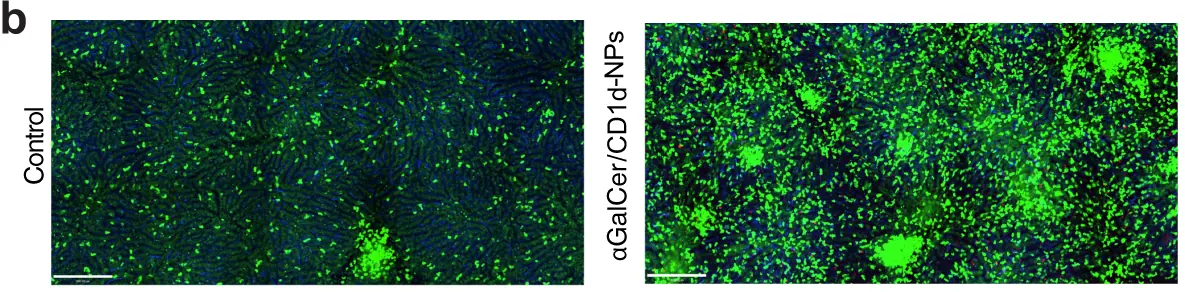
The two microscopy observations accompanying this article come from the 2022 study. They show fluorescently labelled cells in mouse livers, in a control and following nanoparticle stimulation. The label includes iNKT and other cells; it does not exclusively identify one of the eight newly described states.
The image locates the tissue and intervention preceding this map. It is not visual proof of the 2026 results or human efficacy. Maintaining that distinction also avoids presenting the earlier work as a new discovery.
Human extension and therapeutic validation remain necessary
Experiments vary in size. Some analyses pool cells from several mice into one sample; thousands of sequenced cells do not equal thousands of independent animals. Methods report random allocation to groups, but investigators were not blinded to the data.
The authors deposited RNA, accessibility and protein datasets in GEO under GSE300961. Availability allows scrutiny without meaning Lyntev reproduced the analysis. The study supplies a map for further experiments on liver inflammation and repair. Transfer to human cells or a therapeutic intervention remains to be demonstrated.
Sources
Documents and reporting consulted for this story.
- Transcriptional nodes governing diversity and effector rewiring of a plastic liver invariant natural killer T cell ecosystemNature Communications — Jun Yamanouchi, Josep Garnica e colaboradores, . Primary source. accessed 27 November 2026
- Supplementary Figures and Tables — liver iNKT transcriptional nodesYamanouchi e colaboradores / Nature Communications, . Primary source. accessed 27 November 2026
- Re-programming mouse liver-resident invariant natural killer T cells for suppressing hepatic and diabetogenic autoimmunityNature Communications — C.S.Umeshappa e colaboradores, . Primary source. accessed 27 November 2026
Topics

Written by
Wellinton OliveiraCEO of Lyntev
Technology with context, original analysis and sources you can consult.