Zurich team automates synthesis of 56 ubiquitin chain types
ETH Zürich prepared 14 four-unit types and 42 five-unit types. Software generates reagents and instructions for a liquid-handling robot.
By Wellinton OliveiraCEO of Lyntev
Published
4 min read
Key points
- The peer-reviewed article was published in Nature Chemistry on 26 November.
- The 56 types cover only four- and five-unit chains with K48/K63 linkages.
- The configuration allows up to 14 pentamers in parallel, starting from purified dimers.
- Conversion, purity and biological function are different measures.
A team at the Swiss Federal Institute of Technology in Zurich, ETH Zürich, has combined chemistry, enzymes and programming to prepare 56 types of ubiquitin chain automatically. The study published in Nature Chemistry on 26 November presents 14 four-unit chains and 42 five-unit chains, limited to K48 and K63 molecular linkages.
The date refers to the peer-reviewed publication. The software’s official repository identifies an earlier version of the work, posted on ChemRxiv on 11 September 2025. The result is not being presented here as first disclosed in November 2026.
The aim is to produce defined materials for investigating cellular processes. Ubiquitin is a small protein capable of forming chains with different linkages and branches. This diversity influences biological signals but makes homogeneous samples difficult to prepare. The work demonstrates a laboratory synthesis platform, without measuring the effects of every chain in cells or organisms.
What was synthesised and what 56 covers
Chains consist of ubiquitin units joined at specific positions. K48 and K63 identify two linkage sites. Differences in order and branching produce distinct structures even when the number of units is the same.
The researchers enumerated and produced possibilities within this restricted space for four and five units. It does not represent every possible ubiquitin chain: other linkage sites, lengths and modifications exist. The paper itself explains that extending the system will require additional chemistry and protecting groups.
| Platform result or condition | Scope reported in the study |
|---|---|
| Four-unit chains | 14 K48/K63-linked types |
| Five-unit chains | 42 K48/K63-linked types |
| Parallel synthesis in the tested configuration | Up to 14 five-unit chains |
| One addition cycle | Approximately ten hours |
The 42 five-unit chains were made in three batches of 14. The count describes neither industrial-scale production nor 56 vials of final product with identical purity. Conversion and purity varied between structures, according to the reported results.
A chemical change makes the sequence suitable for automation
Joining units at the intended site requires some positions to remain temporarily blocked while others are released. The team developed a protecting group called Smac, removable within two hours under the stated conditions. The earlier strategy discussed in the article required 16 hours for that step.
This comparison concerns protecting-group removal. It does not mean that the entire synthesis becomes eight times faster. Each cycle also includes enzymatic conjugation and washes. The researchers combine chemically synthesised ubiquitin monomers, selective protection and enzymes that direct the linkages.
Automation started with purified dimers, two-unit chains, immobilised on magnetic resin. Two addition cycles yield four units and three yield five. Preparing the starting materials remains laboratory work; pressing a button does not create them.
Software turns a chain into a robot protocol
The computational component represents chains as graphs, recording units and connections. It enumerates synthesis routes, removes unworkable paths and selects sequences compatible with the available chemistry. It then produces reagent maps and executable instructions for a liquid-handling robot.
The methods identify the equipment as an Opentrons Flex with cooling, heating, shaking and magnetic-separation modules. The software generates a Python file and specifies the arrangement of plates and mixtures. Computational selection and physical execution are distinct stages of the same platform.
The paper makes the code and application available under an MIT licence and identifies a Zenodo archive. This enables examination of the logic and attempts at reproduction. Code availability alone does not establish independent replication or immediate compatibility with every laboratory.
Observed bands do not mean uniform purity
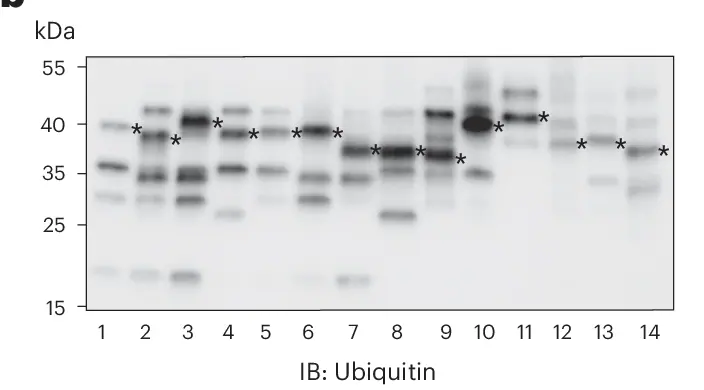
The team checked products using gel separation, immunoblotting and mass spectrometry. In an immunoblot, antibodies make ubiquitin-associated bands visible. The main figure shows signals assigned to the expected products, alongside other bands and differences between reactions.
The authors report that the intended pentamers were the predominant species in the sequences performed. Products at that stage retain protecting groups and a molecular tag used in purification. The article also demonstrates removing those groups and the tag and purifying selected examples, rather than every one of the 56 structures on the same scale.
Obtaining a target in a mixture, isolating it in pure form and showing its biological function are therefore different achievements. The study mainly advances the first task and demonstrates further steps in specific examples. It does not provide a full functional experiment for every topology produced.
Other linkages and replication beyond the tested configuration remain
The peer-reviewed article was accepted on 21 October and published on 26 November. All six authors are affiliated with ETH Zürich’s organic chemistry laboratory and declare no competing interests. Characterisation data and the identified repositories provide material for scrutiny; this report has not repeated the synthesis or reanalysed raw data.
Extending the platform requires chemical systems for other linkage sites and their integration into the automated process. The current result is a defined K48/K63 chain library and a way of converting its planning into laboratory operations, with initial manual intervention and identified scale and purity limits.
Sources
Documents and reporting consulted for this story.
- Comprehensive synthesis of K48/K63 ubiquitin pentamers by graph-empowered automationNature Chemistry — Sohei Majima e coautores, . Primary source. accessed 27 November 2026
- Ubiquitinformatics — software repositoryEric Kummelstedt e coautores. Primary source. accessed 27 November 2026
- Figure5 — outcome of automated synthesisSohei Majima e coautores. Primary source. accessed 27 November 2026
Topics

Written by
Wellinton OliveiraCEO of Lyntev
Technology with context, original analysis and sources you can consult.