Cold War bomb carbon suggests a Scottish killer whale was 65 or older
Counted like tree rings, the layers in a male killer whale’s tooth suggested he was about 50. The chemical trace of Cold War nuclear tests points to 65 or older, and shows that this biological clock slows down in old age.
By Wellinton OliveiraCEO of Lyntev
Published
6 min read
Key points
- A study in Frontiers in Marine Science used the carbon-14 spike from nuclear tests to check the ages of two sperm whales and three killer whales stranded in Scotland.
- In a male killer whale stranded on Uist in 2015, 52 tooth layers suggested an age of about 50, but the oldest layers predate the bomb tests.
- The authors say the animal was potentially 65 or older, but stress that this is not a precise age.
- In both sperm whales and one killer whale the layers track carbon-14 year by year: the authors say it is the first validation of this kind in either species.
- The tooth of the killer whale Lulu carries a different nuclear signature, from Sellafield’s discharges, indicating she lived mostly off western Scotland.
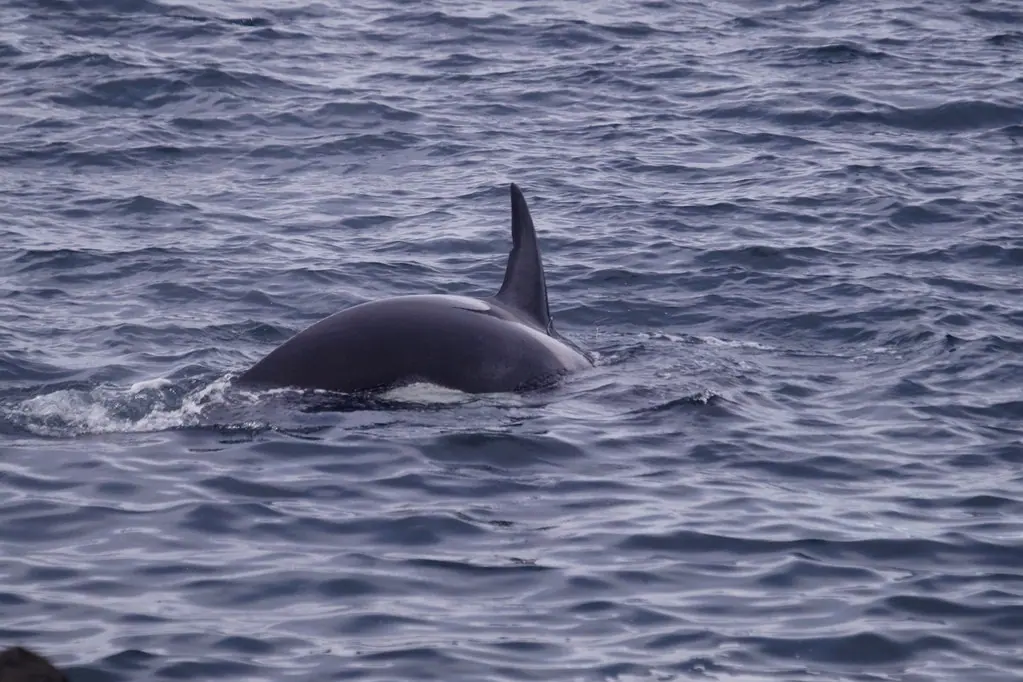
A male killer whale that washed up on the Scottish island of Uist in January 2015 was probably much older than his teeth suggested. The 52 layers counted in one tooth pointed to an age of about 50. Carbon-14 released by Cold War nuclear tests points to 65 or older.
The finding comes from a study published on 1 October in Frontiers in Marine Science, peer-reviewed and open access. The team, led by Kieran Tierney of the SUERC isotope sciences centre at the University of Glasgow, tested the method on killer whales and sperm whales for the first time. The work resurfaced this week after an article in the Spanish technology site Xataka.
How the bombs left a clock in the ocean
The teeth of toothed whales, such as killer whales, dolphins and sperm whales, grow in layers. Each pair of light and dark bands, which biologists call a growth layer group, is treated as one year of life. They are counted like tree rings. The rule has been used for decades but has rarely been checked independently.
Carbon-14 is a slightly radioactive form of carbon found naturally in the air. Atmospheric nuclear tests in the 1950s and 1960s released large amounts of it. According to NOAA’s Global Monitoring Laboratory, levels in the air peaked in late 1963, when the treaty banning those tests came into force.
Since then the excess has been absorbed mainly by the oceans and by plants. This rise and fall is known as the bomb pulse. It passed into plankton, fish and the predators that eat them. Because dentine is barely remodelled once formed, each layer keeps the carbon-14 level of the year it was laid down.
The team measured that level in successive layers with an accelerator mass spectrometer, an instrument that counts carbon-14 atoms in very small samples. The values were then compared with three Atlantic reference curves. A layer with pre-bomb carbon-14 formed before the mid-1950s.
The Uist male did not add up
The researchers analysed five teeth from the archive of the Scottish Marine Animal Stranding Scheme, which examines whales and dolphins stranded in Scotland, and from National Museums Scotland. They came from two sperm whales and three killer whales that died on Scottish shores between 1994 and 2016.
In three of them the method worked as expected. In both sperm whales and in a male killer whale stranded in Shetland in 1995, carbon-14 rose and fell layer by layer in line with the bomb curves. The authors say that, to their knowledge, this is the first time radiocarbon validation has been applied to killer whales and sperm whales. The result supports the one-layer-a-year rule, at least in early and middle life.
One of the sperm whales is Moby, which stranded in the Firth of Forth in 1997 and whose skull is on display at the National Museum of Scotland. His tooth has 43 layers, and the oldest carry pre-bomb carbon-14, which fits that count.
The Uist male told a different story. If each of his 52 layers were a year, he would have been born in the early 1960s, in the middle of the testing era. But his oldest layers carry pre-bomb carbon-14, and the middle ones match earlier years than the count predicted.
The authors’ preferred explanation is compression. With age, the pulp cavity narrows and new layers become thinner and thinner. Eventually several merge into a band that can no longer be told apart. The count stops keeping pace with the years.
The tooth figures, checked against the study
Some coverage simplified the numbers. The paper’s table of counts shows that the result depended on who was looking at the tooth.
| Count in the Uist killer whale’s tooth | Layers |
|---|---|
| First reader, repeated passes | 46 to 49 |
| Second reader | 41 to 47 |
| Final count, on a decalcified section | 52 |
Source: Tierney and colleagues, Frontiers in Marine Science, table 2.
Nor is 65 a measured age. The study says the animal was “potentially” older than 65 and that this is “not a precise age estimate”. It adds that such an age exceeds the longevity typically documented for males of the species.
The University of Glasgow press release of 7 October says “around 65 or perhaps even older”. It describes him as one of the oldest male killer whales on record. Some outlets called him the oldest ever or gave 65 as his exact age, which the paper does not claim.
Lulu and the Sellafield signature
The third killer whale is Lulu, a female from the West Coast Community, the small group of killer whales living off western Scotland. She died on the island of Tiree in 2016 with injuries consistent with chronic entanglement in rope, considered the most likely cause of death.
Her tooth shows no bomb pulse. Its carbon-14 values are high and almost constant, attributed to historic discharges from the Sellafield nuclear reprocessing plant into the Irish Sea. Currents carry that carbon north to Scottish waters.
The authors see this as one of the first demonstrations that carbon released by a civil nuclear facility is recorded in whale teeth. The signal suggests Lulu fed almost entirely off western Scotland. The Uist male lacks it, which lends no support to the idea that he belonged to the same group.
That group is close to vanishing. According to the Hebridean Whale and Dolphin Trust, quoted by the Charlotte Observer in a 2024 article republished by Phys.org, only two known males remain, John Coe and Aquarius. Both are thought to be around 60 or older.
What it changes for biology and conservation
The age of a dead killer whale is used to work out how long the species lives, when it breeds and how much pollution it has accumulated. If teeth underestimate the age of the oldest animals, the species’ lifespan may be underestimated too.
Kieran Tierney said in the press release that effective conservation of these animals “depends on how well we understand their life histories”. The team proposes combining layer counts with carbon-14 and with stable isotopes of carbon and nitrogen, which reveal what the animals ate.
Those isotopes showed different diets in the three killer whales. Lulu had the highest nitrogen values, consistent with a diet containing more prey from the top of the food chain. The authors stress that this does not mean she fed only on marine mammals. In the Shetland male, lower values may reflect lower-level prey or feeding further offshore or further north.
Five teeth and an age still to pin down
Tierney acknowledges that a study of five animals is limited in scope. One tooth was analysed per animal, its position in the jaw was not always known, and in two killer whales the layers had to be paired to obtain enough collagen.
The method also has a blind spot. Where Sellafield’s discharges raise local carbon-14, as in Lulu’s case, the bomb curve can no longer be used for dating. Age then depends on the count and other clues alone.
The next step is to apply the test to more old killer whales whose ages are known from photo-identification, to find out at what age the tooth stops counting the years accurately. A dedicated study of Lulu, with finer sampling and mercury analysis, is described as in preparation.
Sources
Documents, reporting and references gathered for this story. Access limits are stated in the text or the reference itself.
A primary source is the origin of a document or statement; it may be the interested party itself. This label does not mean independent confirmation. The list also includes context and image references where relevant.
- Integrating radiocarbon and stable isotopes in odontocete teeth to reveal life historiesFrontiers in Marine Science — Tierney e colegas, . Primary source. accessed 29 November 2026
- Nuclear traces in whales’ teeth helps scientists reconstruct their life storiesUniversidade de Glasgow, . Primary source. accessed 29 November 2026
- The Technical Details: The Bomb SpikeNOAA Global Monitoring Laboratory. Primary source. accessed 29 November 2026
- Rarely seen killer whale duo spotted twice in one week off ScotlandPhys.org (Charlotte Observer, via Tribune Content Agency), . accessed 29 November 2026
- Una orca apareció en Escocia y sus dientes decían que tenía 50 añosXataka, . accessed 29 November 2026
- Experts tested whales’ teeth for nuclear fallout – and accidentally found the oldest killer whale on recordDiscover Wildlife, . accessed 29 November 2026
Topics

Written by
Wellinton OliveiraCEO of Lyntev
Technology with context, original analysis and sources you can consult.